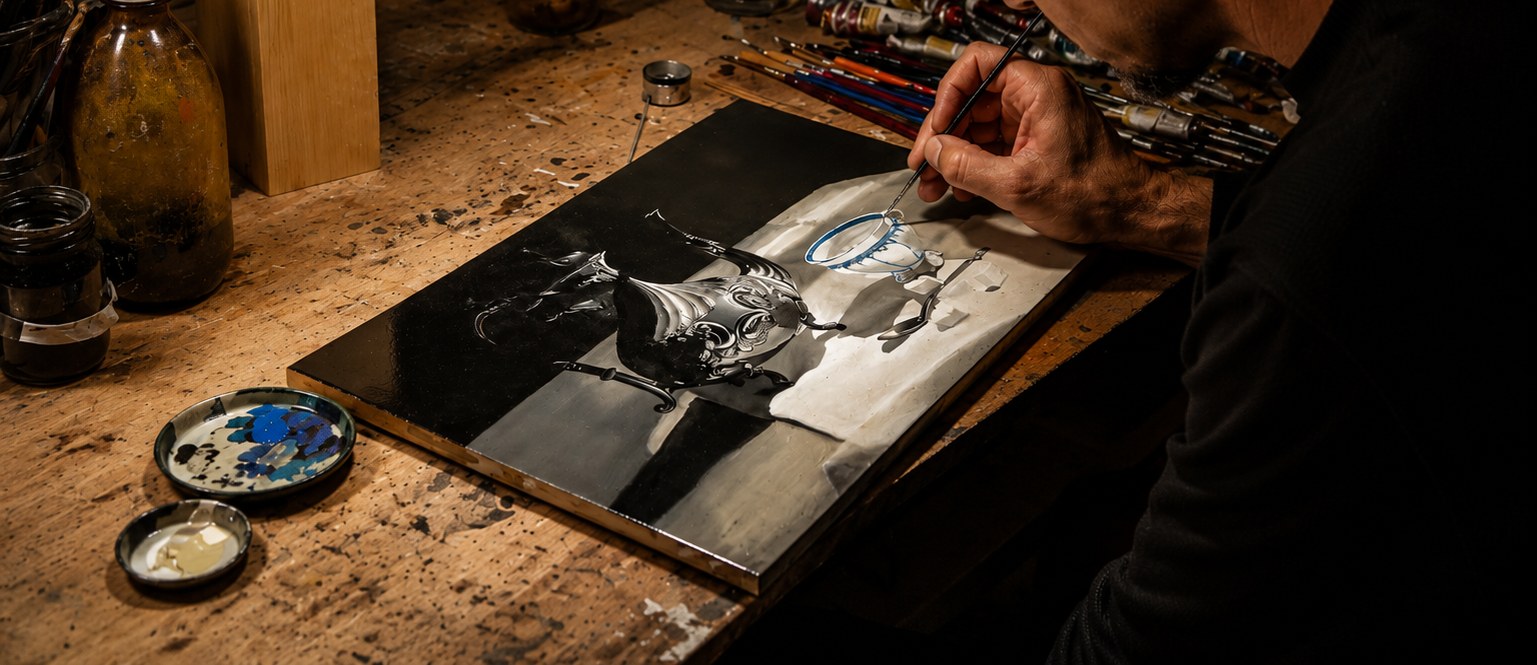
A whole lifetime would not be enough to complete my apprenticeship in a craft this complex — but I will have done my best. — G. A.
Painting, for me, is a way of dwelling slowly in the world.
A portrait painter in my early years, it was still life that revealed the essential to me: the light born from matter, the silence that curls between objects. Nourished by the Flemish masters and seventeenth-century Italian painting, I try to carry this heritage forward through my own eyes — not to repeat it, but to bring it to life differently.
Through amber glazes and pure pigments, I explore transparency, depth, and the mysteries of colour. Between the memory of tradition and a personal quest, I pursue that fragile, ever-threatened balance between shadow and light.
A slow painting. Demanding. Inhabited.
Today, everywhere, tools and products promise a quick way into painting's "deep end." But I believe we are collectively losing a craft — and that this is especially true in this trade. I do not want to keep what I have learned for myself alone, nor let it disappear with me one day.
Very early on, I was fascinated by the glazes of the Flemish painters, particularly amber ones — they had found a way to give a subject its depth, its contours, the truth of its colours. History has left no trace of how they were made. So I let Baltic amber macerate for five years, in a solution I keep secret, until obtaining a pure amber, clear as honey. The result was worth the wait.
Pure pigments, natural binders, the choice and preparation of the support: every material shapes the quality of the whole, and with each new work I try to adapt the support to the subject, rather than the other way round.
I do not rule out contemporary or abstract subjects, but pure realism has always been my unwavering preference — a taste for the true, the authentic, even against the grain of current trends. No technology will ever replace the brush or the painter's conviction: painting remains, more than any other mode of expression, a vector of emotion.
It is this demanding — yet, I believe, very accessible — conception of painting that I would like to pass on, through my works as much as through workshops, lessons, and exchanges with those who, like me once, wish to learn.
Gilles Aguilera
One does not become an artist — one is born that way, it's genetic, you feel it, you sense it. A fine trade, perhaps the oldest in the world... but a path as difficult as a life shared as a couple, with its highs and lows.
Since childhood, I have known that I can "control" people's emotions through my painting. I always knew it was a gift, one that had to be cultivated and explored, in spite of passing trends and pseudo-intellectual critics. So I carried on...
So many mixtures, year after year — the oils evaporate, the smell of resin lingers, the pigments drawn from iron oxide rust my jars. Egg yolk, the one dish of substance in this simple cuisine... and yet so difficult.
A thin layer, or a light veil, always with the same apprehension before each of my works. I remain that curious child, filled with wonder, a student of life — grateful to da Vinci, Chardin, and Corot for opening my eyes. Now I know: I have understood that everything is far more transparent than it seems.
Hoping that your gaze will be more curious than admiring — to the point of wanting, in turn, to show others what moves you most...
Gilles Aguilera
Claire Simonnot: Light is very present in your paintings — where does this sensitivity come from?
Gilles Aguilera: As a child, I used to place an object on the ground and watch its shadow, observing how it moved with the sun.
C.S.: Like a sundial?
G.A.: Yes, I found it intriguing — I also played with my own shadow. What I really love is relief: shadows are what give things their dimension, otherwise everything would be flat!
C.S.: Was it your father who gave you the taste for painting?
G.A.: My father had studied at the Beaux-Arts in Toulouse, with honours, and watching him draw, alongside his architect friend, undoubtedly marked my imagination.
C.S.: Would you say he encouraged you?
G.A.: Yes and no — I wanted to learn and I wasn't very patient... but I loved drawing. One day he told me: "Sit there." He placed an egg in an eggcup on the mantelpiece and asked me to draw what I saw, so that, sitting in the same spot, he could later see exactly what I had seen.
C.S.: And the result?
G.A.: It took me a year and a half to finish it...
C.S.: Could it have ended there?
G.A.: I had gotten there! And I had learned without realising it. I noticed that we sometimes look without truly seeing. Observing that egg taught me to understand all of this.
In his analysis of Gilles Aguilera's work, art critic Hubert d'Albas does not hesitate to place him alongside Johannes Vermeer — not as an imitator, but as a "very serious rival," and a far more prolific one than the master of Delft, who painted only two or three canvases a year.
He identifies deep affinities between the two artists: a mastery of composition, an almost geometric construction of harmony, the distribution of colour, and a shared skill in creating depth from nothing more than the interplay of shadow and light.
What strikes Hubert d'Albas most is the precision of the material itself — the roundness of a fruit, the down of a peach, the transparency of a grape — a rendering he describes as an almost perfect expression of beauty, capable of holding the connoisseur's gaze indefinitely.
— Hubert d'Albas, art critic, Éditions Fus Art